70%
of NYC carbon emissions come from buildings — far above the national norm

As the city enforces the most ambitious building-emissions law on the planet, a passive, electricity-free regulator is becoming one of the most cost-effective ways to cut energy waste and stay on the right side of Local Law 97.
In 2019 New York passed the Climate Mobilization Act, and at the heart of it sat Local Law 97 — a measure widely considered the most far-reaching building-emissions law any city has ever enacted. After a five-year ramp-up, it is now in full force, and the consequences are landing on owners across all five boroughs.
The logic is simple. Any building over 25,000 square feet must keep its annual greenhouse-gas emissions under a strict cap or pay for the overage. Because buildings generate close to 70% of the city's carbon — a much larger share than in places where cars and trucks dominate — going after how buildings use energy isn't just reasonable. For New York, it's the only way the math works.
The law was also built to get harder on a schedule. The first compliance window, running through 2029, was set at a level most buildings could reach with modest tune-ups. What arrives in 2030, 2035, and beyond is what will separate the owners who invested early from the ones who waited.
Every building above a certain size has to meet the new limits — but you can't act on what you can't measure, and you can't reduce what you can't control.
The law reaches three kinds of property: a single building over 25,000 gross square feet; any cluster of buildings on one tax lot adding up to more than 50,000; and condo-board portfolios that cross the same 50,000-square-foot line.
In practice that pulls in roughly 50,000 properties and more than 22,000 individual parcels — precisely the buildings that matter most for the city's climate goals.
About 11% of covered buildings are estimated to be over their limit on day one. The first annual report was due May 1, 2025.
Limits tighten sharply. Without real efficiency, electrification, or renewables, as many as 80% of buildings could exceed their new caps. This is the watershed.
Caps fall again, and heavier capital work is expected across portfolios — especially for buildings still leaning on gas heat.
Every covered building must hit a net-zero carbon standard — the end point of a 30-year decarbonization journey already well underway.
Charged per metric ton of CO₂-equivalent over the cap, every year. A large office that runs 1,000 tons over — not unusual for a non-compliant property — faces $268,000 for that year alone.
Assessed for every month a report is late, with a $1,250 monthly minimum — entirely separate from any emissions penalty. Across non-compliant buildings, REBNY projects citywide penalties could climb from an estimated $200 million in 2025 to more than $900 million a year by 2030.
Annual emissions reports covering the prior calendar year must be filed with the NYC Department of Buildings and certified by a licensed Professional Engineer or Registered Architect. Miss it, and the per-square-foot penalty starts ticking on top of any exceedance fine.
The path for most large commercial and residential buildings. Keep annual carbon emissions below the limit assigned to the property's type and size, and file by May 1 each year.
An alternative mainly for housing — buildings with 35%+ rent-regulated units, houses of worship, and certain affordable classes. Instead of a hard cap, they complete low-cost conservation measures or meet their 2030 limit early, acknowledging the financial realities affordable operators face.
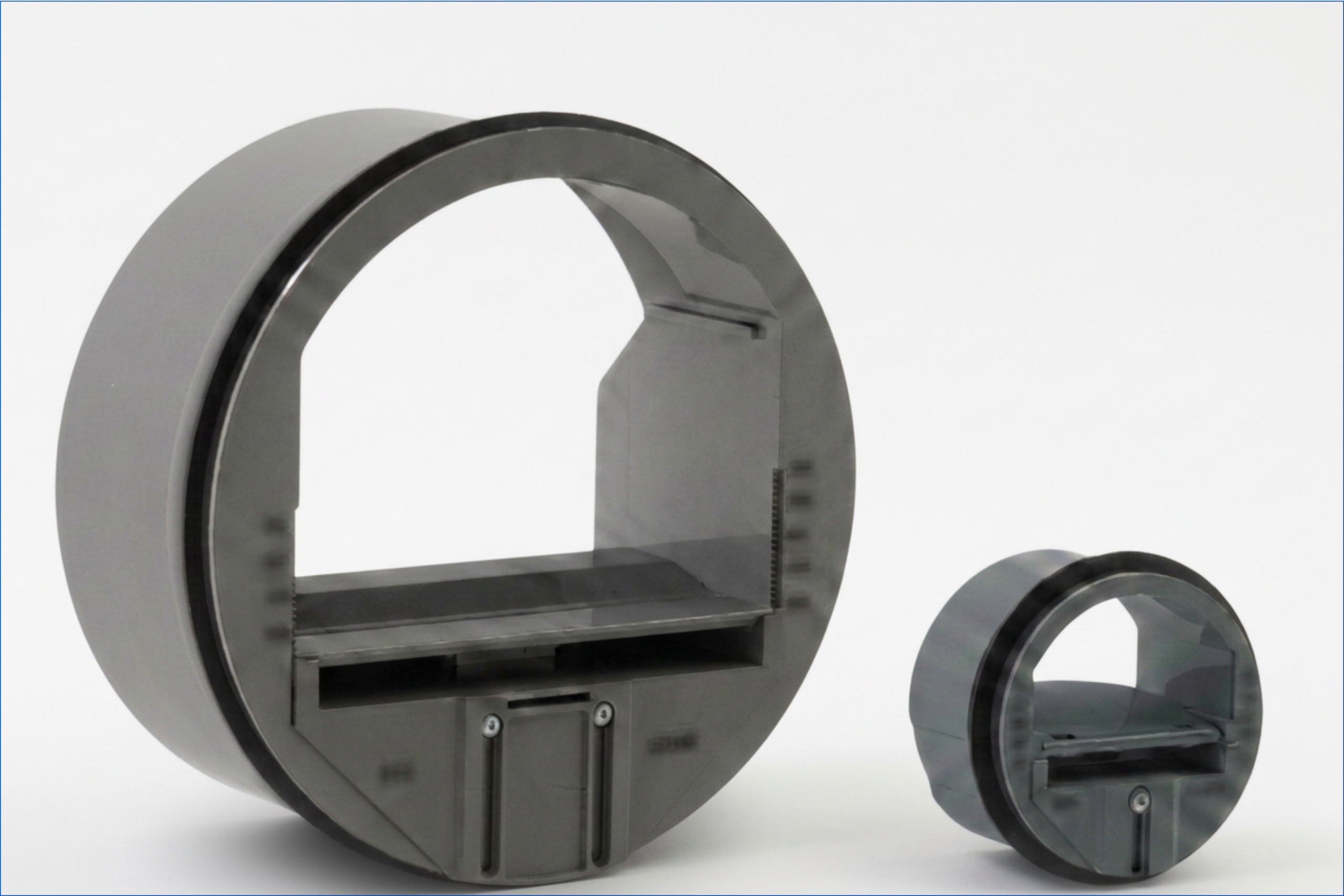
The eFlow-CAR is a passive constant airflow regulator designed to keep ventilation automatically balanced without electricity, sensors, or ongoing recalibration. Installed directly in the ductwork, it automatically responds to pressure changes to maintain consistent airflow — helping buildings reduce wasted energy while supporting proper ventilation performance.
In the conversation around Local Law 97, much of the attention has gone to major capital upgrades: heat-pump conversions, rooftop solar, lighting retrofits, and advanced building controls. But one of the most practical opportunities for reducing energy waste is often hidden inside the ductwork.
The eFlow Constant Airflow Regulator offers a different approach. Rather than relying on electricity, sensors, programming, or ongoing calibration, the eFlow-CAR uses a passive mechanical design to maintain consistent airflow as building conditions change.
Inside the regulator, a self-adjusting aero-wing and spring-piston mechanism respond automatically to pressure variations caused by stack effect, weather, seasonal changes, and dust loading. Once the desired CFM is set with a screwdriver, the device continuously regulates airflow within ±5% across its operating pressure range — with no power, no controls, and no routine recalibration required.
No electricity, no sensors, no controls to maintain. The mechanism adjusts itself to changing duct pressure for the life of the building.
Holds the set airflow within a tight tolerance across low-, standard-, and high-pressure duct systems — floor to floor, season to season.
Calibrated on site to the desired CFM, then left to run automatically — maintenance-free under normal conditions and UL 2043 Classified.
Over-ventilation is one of the most common — and most overlooked — sources of energy waste in large buildings. When exhaust fans pull more air than a space actually needs, the HVAC system has to condition all that extra replacement air: heating it in winter, cooling it in summer. Multiply that across a 500-unit high-rise and the waste becomes substantial, inflating both the energy bill and the carbon ledger at the same time.
An eFlow-CAR closes that gap by delivering exactly the airflow each space requires — no more, no less — regardless of what duct pressure is doing elsewhere in the building. Less unnecessary load on fans, air handlers, and conditioning equipment means lower energy use, which means lower reported emissions and a smaller compliance burden under the law’s carbon caps. Better-controlled ventilation also lifts indoor air quality, feeding directly into LEED credits and Passive House certification — the kind of third-party validation regulators, lenders, and tenants increasingly look for.
Inside thousands of apartments, offices, dormitories, and hospitals, small passive devices are quietly balancing airflow and saving energy.
These aren't pilots. eFlow-CARs are installed and performing in major projects across the country — from New York high-rise towers to hotels, campuses, and commercial complexes — proving themselves exactly where balanced ventilation is hardest to hold.
758,000 sq ft across three towers rising up to 20 stories. eFlow-CARs counter the severe stack-effect pressure swings inherent to tall buildings, holding ventilation steady from the lobby to the top floor of every tower.
499 unitsIn a luxury Manhattan tower, eFlow-CARs deliver the quiet, maintenance-free airflow precision high-end residents expect — balanced ventilation with no sensors, no power, and no recalibration.
LuxuryA modern waterfront residential development where eFlow-CARs provide apartment-by-apartment airflow control, lifting indoor air quality while curbing the over-ventilation that quietly inflates energy use.
ModernAcross twin high-rise towers, eFlow-CARs tame the pressure variations that throw tall buildings out of balance — keeping airflow consistent floor to floor through every season.
Twin towersThrough 331 guest rooms, eFlow-CARs keep ventilation balanced and air quality uniform in a high-occupancy hotel — comfort guests notice, without the ongoing balancing and maintenance a busy property can't spare.
331 roomsA multi-building campus deployment using eFlow-CAR Dual Flow regulators to balance ventilation across varied institutional spaces while easing the energy load on the central HVAC plant.
Multi-buildingWhat makes the eFlow-CAR so well-suited to the LL97 problem is the economics. Owners staring down the 2030 cliff need a portfolio of moves — and not every one can be a heat-pump retrofit or a rooftop solar array. Those carry heavy capital costs and often demand structural, electrical, and regulatory work that takes years.
CARs are passive, maintenance-free under normal conditions, and UL 2043 Classified. They drop into existing duct systems during routine maintenance windows without disrupting a working building, get dialed in on site with a screwdriver, and then run on their own. Because they cut the wasted ventilation load that drives excess emissions, they can make a meaningful contribution to a building’s compliance position — especially in buildings that have been over-ventilating for years. Factor in the market value of LEED credits and Passive House status — rent premiums, easier financing, tenant demand — and the case only gets stronger.
The politics around Local Law 97 keep shifting — 2025 saw City Council proposals to ease requirements for co-ops, condos, and garden-apartment complexes, reflecting genuine financial pressure on some building types. But whatever gets amended, the direction is fixed: New York's buildings will decarbonize substantially over the next two decades, and the cost of waiting climbs with every compliance period.
The smartest strategies will stack interventions at different price points. Fuel switching and electrification will carry the big structural reductions. Passive, precise ventilation control — the job eFlow-CARs do — forms the foundation layer beneath them, trimming baseline waste so the expensive measures have less work to do and compliance lands more reliably across a portfolio. New York is writing the playbook for building decarbonization at scale, and inside thousands of apartments, offices, dormitories, and hospitals, small passive devices are quietly doing their part.
eFlow-MAX+ regulators are factory-calibrated, code-compliant, and ready for rapid deployment.
Join our Authorized Product Rep Network — no restrictions, with fast shipping, technical support, and proven performance. Become a rep →